
Home / Services / Computer Vision Development
Turn images into information for a defined task.
Assess image-based classification, detection and similarity workflows using representative examples. Consider capture conditions and review requirements alongside model performance.
 ★★★★★5.0· 57 client reviews
Overview
Computer Vision Development, explained
Computer vision lets software understand images and video: detecting objects, reading text, checking quality or measuring change. It is valuable wherever people currently look at photos, scans or camera feeds to make routine decisions.
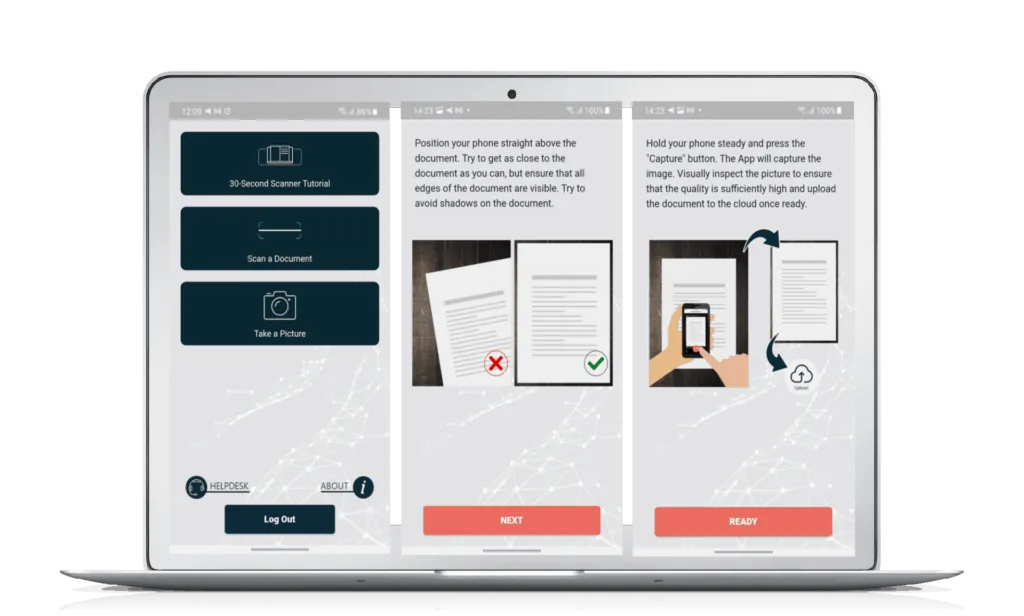
We build vision systems from data collection and labelling to model training, deployment and the application around it. Our portfolio includes a mobile app that scans PDFs and images to extract text for scientific work, and we apply the same disciplined approach to inspection, document capture and media workflows.
Before you build
Decisions worth settling first
Settling these points early keeps scope realistic and makes the estimate meaningful.
01
Visual task
Define exactly what must be detected, read or measured and the acceptable error rate.
02
Image conditions
Review lighting, angles, resolution and variation in real-world images.
03
Labelled examples
Plan how many images are needed and who will label them.
04
Where it runs
Choose cloud, edge device or mobile based on speed, cost and connectivity.
05
Exception handling
Decide what happens with low-confidence results.
06
Privacy
Consider faces, licence plates and personal data in images.
Services
What our computer vision development services include
Object detection
Locate and count items, people or defects in images and video.
Image classification
Sort images into categories for tagging, routing or quality control.
OCR and document capture
Extract text and fields from photos, scans and PDFs.
Visual inspection
Detect defects or missing components on production lines.
Video analytics
Analyse video streams for events, movement or activity.
On-device vision
Run models in mobile apps for instant results without a connection.
How it is built
The layers behind a dependable result
Every layer has an owner, tests and documentation, so the system can be supported after launch.
01
Data collection
Capturing representative images and labelling them consistently.
02
Model training
Training and validating models on varied, realistic data.
03
Deployment
Serving models in the cloud, on edge hardware or in mobile apps.
04
Review loop
Interfaces for checking uncertain results and improving the model.
Use cases
Where it helps
Manufacturing
Defect detection and assembly verification.
Logistics
Package scanning, label reading and damage checks.
Retail
Shelf monitoring and product recognition.
Science and research
Image analysis and text extraction from scanned material.
Construction and property
Progress photos, site inspection and measurement.
Insurance and claims
Photo-based damage assessment support with human review.
Illustrative use case
A catalogue team can explore visually similar items and review candidate matches before updating a record.
From our portfolio
Image Processing System
A mobile app, built with scientists in the US, that scans PDFs and images to extract text and process images.
FlutterPythonAngularAWSiOS & Android
Why PoliteTech
Why teams choose PoliteTech
Scope before commitment
Priorities, assumptions and acceptance criteria are agreed in writing before a delivery plan is fixed.
Engineers who build
Recommendations come from the people who design, code and support the software, so they reflect real implementation effort.
Visible progress
A shared backlog, regular demos and recorded decisions keep you informed without chasing updates.
Practical AI
Evaluation sets, review steps, cost limits and monitoring are part of every AI feature we ship.
Flexible engagement
Start with a scoped project, a dedicated team or support, and change the model as your roadmap evolves.
Clear ownership
Repositories and accounts can live in your organisation, with IP and confidentiality terms agreed in the contract.
Industries
Where this work fits
Retail and Ecommerce
Build web and mobile journeys around product discovery, ordering and customer service.
Financial Software
Support reporting, document processing and internal operations through defined application workflows.
Logistics Software
Connect planning, task assignment and operational updates in one workflow.
Education and Elearning
Create platforms for content, activities and progress tracking.
Fitness and Wellness Apps
Support tracking, coaching content and user engagement around a clear product goal.
Manufacturing Software
Replace fragmented tracking with workflows for quotations, work status and supporting documents.
Real Estate Applications
Create listing, enquiry and internal coordination tools around your business process.
Business Operations
Build task, approval and reporting tools around the way your team works.
Process
A practical path from requirements to release.
Each stage ends with something you can review: a scope, a prototype, a working increment or a release.
01
Understand
Discuss your users, business needs, existing systems and delivery constraints.
02
Define
Agree scope, technical approach, responsibilities and a delivery plan.
03
Design and build
Develop in manageable increments with visible progress and review points.
04
Test and release
Validate agreed workflows, resolve release blockers and prepare deployment.
05
Support and improve
Document the handover, review production feedback and plan the next priorities.
Technology
Tools and platforms we work with
PythonOpenCVPyTorchTensorFlowYOLODetectron2Tesseract OCRGoogle Vision APIAWS RekognitionAzure AI VisionCore MLTensorFlow LiteFlutterNVIDIA Jetson
Cost
What shapes the cost of your project?
There is no useful price without scope. These are the factors we review when preparing an estimate, and the estimate lists every assumption so you can see what would change it.
01
Number of workflows
Each workflow needs its own prompts, tools, evaluation set and review design.
02
Data preparation
Cleaning, labelling, chunking and access rules often take more effort than the model itself.
03
Integrations
Connections to CRMs, ERPs, document stores and identity providers add design and testing work.
04
Evaluation and review
Building test sets, review queues and monitoring is essential for reliable results.
05
Model and hosting
Hosted APIs, open models and private deployment have very different setup and running costs.
06
Security and compliance
Sensitive data, audit needs and data residency add controls and documentation.
Engagement models
Choose the engagement that fits your next step.
Dedicated Team
For a changing roadmap or ongoing development. Agree roles and working process, then manage priorities through a shared backlog.
Best for team extension and long-term product work.
Scoped Project
For a defined product or milestone. Align on requirements, deliverables and acceptance criteria, with changes reviewed before they affect the plan.
Best for MVPs, integrations and focused releases.
Maintenance and Improvement
For software that already exists. Start with a technical review, then agree support routines and planned improvements.
Best for live applications and modernisation.
FAQ
Questions about computer vision development
How many images do we need?
It depends on task complexity and variation. Pretrained models reduce the number needed; we estimate after reviewing samples.
Can it work on a phone?
Yes. Models can run on-device with Core ML or TensorFlow Lite, as in our mobile image processing project.
How accurate will it be?
Accuracy depends on image quality and task. We agree a target, measure on held-out data and design review for uncertain cases.
Can you use our existing cameras?
Often yes, if resolution and angles are suitable. We assess sample footage first.
Do you handle labelling?
We can organise labelling with tools and guidelines, or work with your domain experts for specialist images.
What about privacy?
We can blur or avoid storing personal features and process images in your own environment.
Can we begin with a focused scope?
Yes. We can review your current situation and agree a bounded first engagement before a wider build.
How are pricing and timelines determined?
We review requirements, technical complexity, team needs and delivery constraints before proposing an engagement. Estimates list assumptions and what may change the plan.
Can we discuss a project under an NDA?
Yes. Let us know before sharing confidential materials so we can agree confidentiality terms first.
Discuss your computer vision development needs
Share your goals, current situation and the help you need. We will review your message and suggest a practical next step.