Practical AI development for products and business workflows.
Turn a specific business problem into an AI feature your team can evaluate, integrate and operate. We help define the use case, review the available data and build the surrounding application workflow.
 ★★★★★5.0· 57 client reviews
Overview
AI and Data, explained
AI is useful when it removes a specific bottleneck: a queue of documents nobody has time to read, a search box that never finds the right answer, a decision that depends on information scattered across systems. Our AI and data work starts from that bottleneck rather than from a model. We define what a good result looks like, check whether your data can support it and then build the smallest version that proves the value.
From there we design the surrounding software that makes AI dependable in daily use: permissions, review screens, fallbacks when the model is unsure, logging, cost controls and monitoring. The result is a feature your team can evaluate, operate and improve, not a demo that only works on hand-picked examples.
Before you build
Decisions worth settling first
Settling these points early keeps scope realistic and makes the estimate meaningful.
01
The task and the decision it supports
Name the workflow, who uses the output and what they do with it. A clear decision point makes it possible to judge whether the AI is actually helping.
02
Data access and permission
Confirm which data the system may read, where it is stored and who approved its use. Data readiness usually determines scope more than model choice does.
03
What counts as a good answer
Agree evaluation examples and acceptance criteria before development, including the difficult and ambiguous cases.
04
Human review points
Decide where a person must approve, correct or override the output, especially when an error has a cost.
05
Running cost and latency
Estimate usage volume, acceptable response times and the cost per task so the design fits the budget in production.
06
Ownership after launch
Plan who monitors quality, updates prompts or models and handles user feedback once the feature is live.
Services
What our AI and data services include
AI use case discovery
Workshops and technical review to rank opportunities by value, feasibility and data readiness, ending in a scoped pilot plan.
AI agents and automation
Agents that gather context, call approved tools and prepare actions for review inside your business systems.
Generative AI features
Drafting, summarising, classification and content generation built into your product with guardrails and review.
Knowledge search and RAG
Search and question answering over your documents with source citations and access control.
Document processing
Extraction and validation of data from invoices, forms, contracts and scanned files, with exception handling.
Machine learning models
Prediction, recommendation and classification models trained and evaluated on your own data.
Computer vision and NLP
Image, video and language processing for inspection, tagging, transcription and text analysis.
AI integration
Connecting models to web and mobile apps, APIs, databases and existing workflows.
How it is built
The layers behind a dependable result
Every layer has an owner, tests and documentation, so the system can be supported after launch.
01
Data layer
Connectors, cleaning, chunking and access rules that decide what the system can see and when.
02
Model layer
Hosted or self-hosted models selected for quality, cost, latency and data-residency needs.
03
Application layer
The interface, review screens, business rules and integrations your users actually touch.
04
Operations layer
Logging, evaluation, monitoring, cost tracking and a process for improving results over time.
Choosing an approach
Which approach fits your problem?
| Approach | What it does | Best for |
|---|---|---|
| Rules and scripts | Follows fixed logic you define | Stable, predictable steps with no ambiguity |
| Machine learning model | Predicts or classifies from historical data | Repeated decisions with good labelled data |
| LLM feature | Reads and writes language on request | Drafting, summarising and question answering |
| RAG system | Answers from your documents with citations | Knowledge that changes and must be traceable |
| AI agent | Plans steps and uses approved tools | Multi-step tasks with clear permissions and review |
Use cases
Where it helps
Support teams
Draft replies, summarise tickets and surface relevant knowledge-base articles for agents.
Finance and operations
Extract invoice and order data, flag exceptions and route items for approval.
Sales and account teams
Summarise accounts, prepare briefings and search proposals and contracts.
Product teams
Add assistants, smart search or personalised recommendations to customer-facing apps.
Knowledge workers
Find answers across policies, manuals and project documents with cited sources.
Field and quality teams
Use photos and forms to capture, classify and check information on site.
From our portfolio
AI Art Generation
A text-to-image experience built on Stable Diffusion that turns written prompts into artwork.
PythonStable DiffusionReact NativeNode.jsAWS

Why PoliteTech
Why teams choose PoliteTech
Scope before commitment
Priorities, assumptions and acceptance criteria are agreed in writing before a delivery plan is fixed.
Engineers who build
Recommendations come from the people who design, code and support the software, so they reflect real implementation effort.
Visible progress
A shared backlog, regular demos and recorded decisions keep you informed without chasing updates.
Practical AI
Evaluation sets, review steps, cost limits and monitoring are part of every AI feature we ship.
Flexible engagement
Start with a scoped project, a dedicated team or support, and change the model as your roadmap evolves.
Clear ownership
Repositories and accounts can live in your organisation, with IP and confidentiality terms agreed in the contract.
Industries
Where this work fits
Retail and Ecommerce
Build web and mobile journeys around product discovery, ordering and customer service.
Financial Software
Support reporting, document processing and internal operations through defined application workflows.
Logistics Software
Connect planning, task assignment and operational updates in one workflow.
Education and Elearning
Create platforms for content, activities and progress tracking.
Fitness and Wellness Apps
Support tracking, coaching content and user engagement around a clear product goal.
Manufacturing Software
Replace fragmented tracking with workflows for quotations, work status and supporting documents.
Real Estate Applications
Create listing, enquiry and internal coordination tools around your business process.
Business Operations
Build task, approval and reporting tools around the way your team works.
Process
A practical path from requirements to release.
Each stage ends with something you can review: a scope, a prototype, a working increment or a release.
01
Understand
Discuss your users, business needs, existing systems and delivery constraints.
02
Define
Agree scope, technical approach, responsibilities and a delivery plan.
03
Design and build
Develop in manageable increments with visible progress and review points.
04
Test and release
Validate agreed workflows, resolve release blockers and prepare deployment.
05
Support and improve
Document the handover, review production feedback and plan the next priorities.
Technology
Tools and platforms we work with
PythonPyTorchTensorFlowscikit-learnOpenAIGoogle GeminiLlamaMistralHugging FaceLangChainLlamaIndexpgvectorElasticsearchFastAPINode.jsAWSAzureGoogle CloudDocker
Cost
What shapes the cost of your project?
There is no useful price without scope. These are the factors we review when preparing an estimate, and the estimate lists every assumption so you can see what would change it.
01
Number of workflows
Each workflow needs its own prompts, tools, evaluation set and review design.
02
Data preparation
Cleaning, labelling, chunking and access rules often take more effort than the model itself.
03
Integrations
Connections to CRMs, ERPs, document stores and identity providers add design and testing work.
04
Evaluation and review
Building test sets, review queues and monitoring is essential for reliable results.
05
Model and hosting
Hosted APIs, open models and private deployment have very different setup and running costs.
06
Security and compliance
Sensitive data, audit needs and data residency add controls and documentation.
Engagement models
Choose the engagement that fits your next step.
Dedicated Team
For a changing roadmap or ongoing development. Agree roles and working process, then manage priorities through a shared backlog.
Best for team extension and long-term product work.
Scoped Project
For a defined product or milestone. Align on requirements, deliverables and acceptance criteria, with changes reviewed before they affect the plan.
Best for MVPs, integrations and focused releases.
Maintenance and Improvement
For software that already exists. Start with a technical review, then agree support routines and planned improvements.
Best for live applications and modernisation.
FAQ
Questions about AI and data
Can you add AI to an existing product?
Yes. We review the current architecture, data and user workflow first, then recommend an integration approach that avoids rebuilding parts that already work.
Do we need a lot of data to start?
Not always. Many language features work with a small set of good examples and your existing documents. Prediction models usually need more historical data, and we check this during discovery.
Which models do you use?
We work with hosted models such as OpenAI and Google Gemini and open models such as Llama and Mistral. The choice depends on quality, cost, latency and where your data is allowed to go.
How do you prevent wrong answers from causing problems?
We design evaluation sets, confidence thresholds, source citations, review steps and fallbacks so uncertain outputs are flagged instead of acted on automatically.
Can AI outputs require human approval?
Yes. Review and escalation steps can be built into any workflow where an incorrect result would create operational, financial or customer risk.
How is pricing determined?
Pricing follows scope: the number of workflows, integrations, data preparation, evaluation effort and the engagement model. We provide an estimate after a short discovery.
Who owns the code and the trained models?
Ownership of code, models and other deliverables is defined in the agreement for each engagement, including how third-party and open-source licences apply. See our IP protection page for how we handle this.
What happens after the pilot?
If the pilot meets the agreed criteria, we plan the production build: hardening, integrations, monitoring and handover, or ongoing improvement with a dedicated team.
How are pricing and timelines determined?
We review requirements, technical complexity, team needs and delivery constraints before proposing an engagement. Estimates list assumptions and what may change the plan.
Can we discuss a project under an NDA?
Yes. Let us know before sharing confidential materials so we can agree confidentiality terms first.
Our work
More AI projects
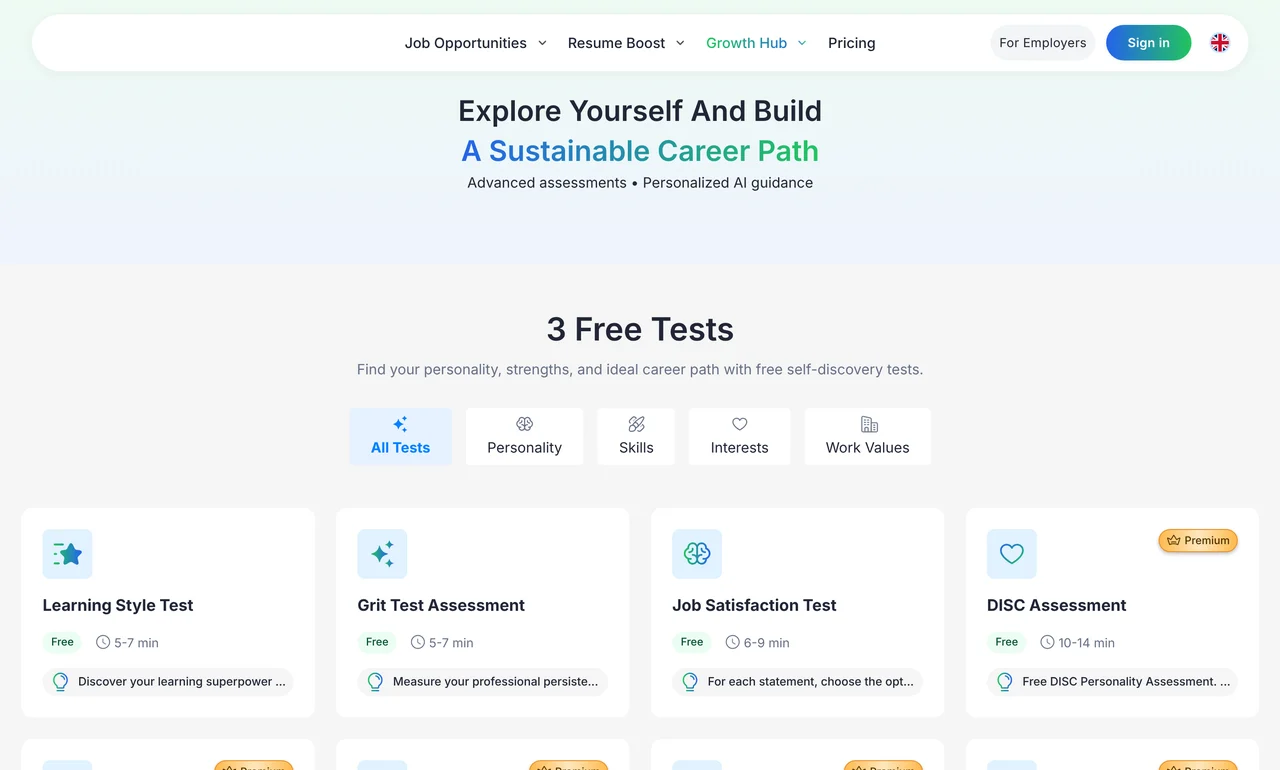
HR & recruitment · Web
AI Career Platform
A career platform for job seekers in Southeast Asia that brings together job discovery, AI resume tools and career guidance.
Next.jsReactMaterial UIZustand
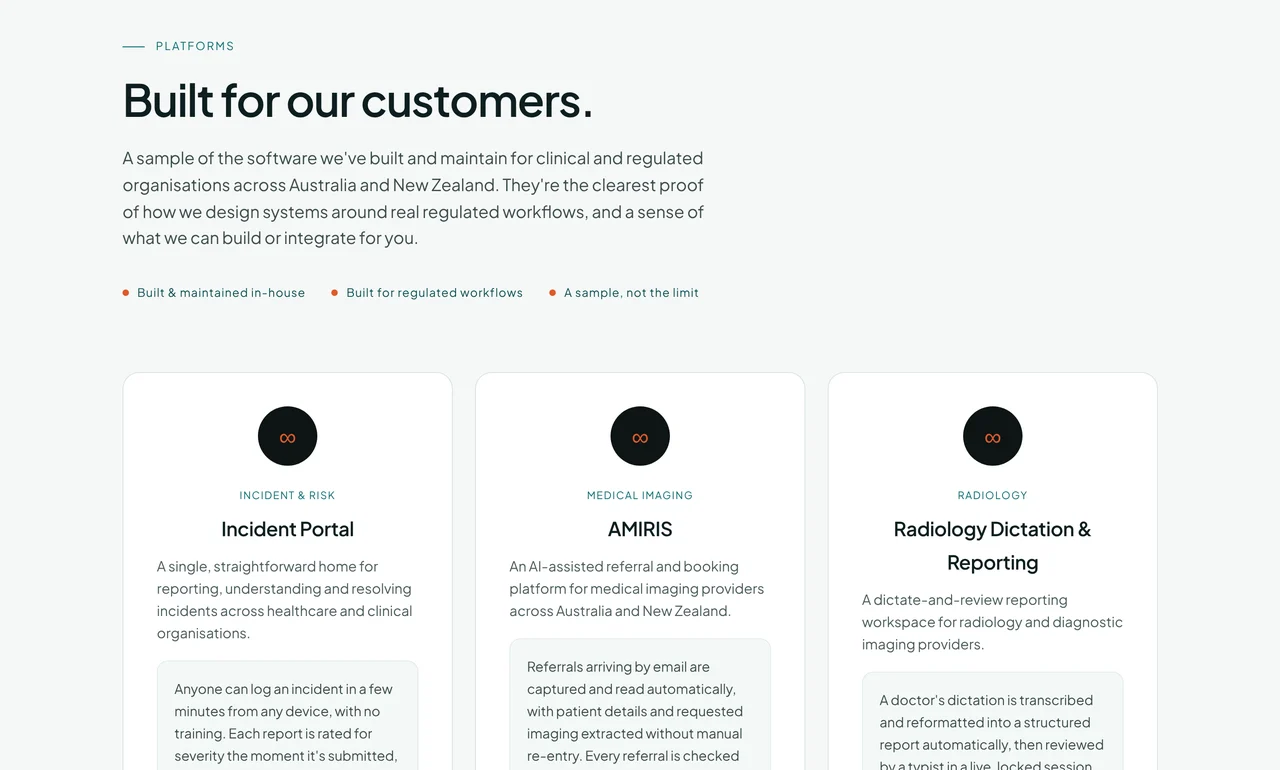
Healthcare · Web
Clinical Operations Platform Suite
A suite of platforms for Australian clinical and regulated organisations, covering incident reporting, imaging referrals, radiology reporting, occupational health and medico-legal cases.
Web platformsAI referral processingDictation to reportAccounting integration
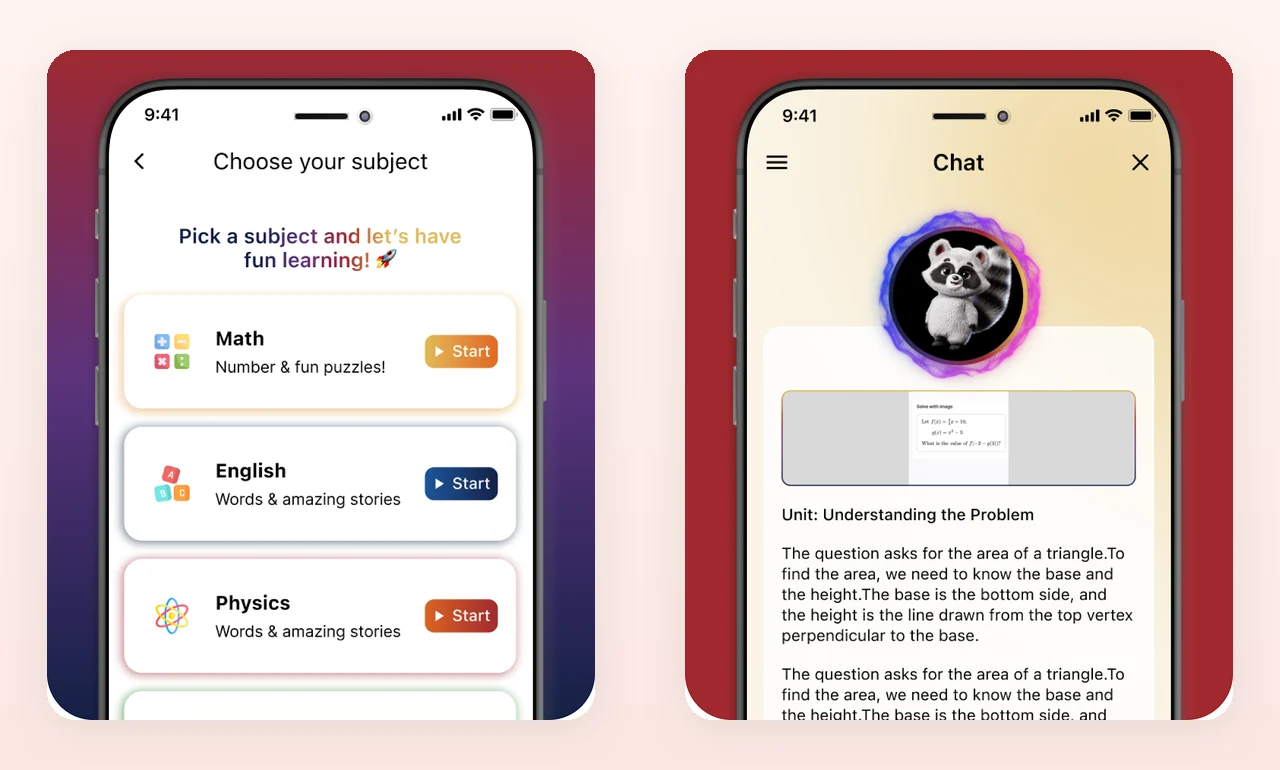
Education & family · Mobile
AI Study Companion
A mobile AI tutor that helps children aged 6 to 18 with homework, exam preparation and reading, explaining step by step instead of giving answers.
React NativeNext.jsGoogle CloudiOS
Discuss your AI and data needs
Share your goals, current situation and the help you need. We will review your message and suggest a practical next step.